Operational Intelligence System for NIH (NIHOIS)
An Agentic AI system that coalesces information relevant to an agency's operations and delivers personalized daily debreifs to inform of room for growth and collaboration across the organization
Proof of Concept designed, built, and demonstrated effective April 2026
Case Study: NIH Operational Intelligence System (NIHOIS)
Background
The National Institutes of Health (NIH) is not one centralized organization, but 27 different Institutes, each with their own programs, projects, and priorities. As such, any office attempting to coordinate efforts across that space has several questions to answer on a standing basis:
- What recent changes in the federal budget or policy may impact the agency's projects or personnel,
- Which projects have too many personnel and not enough funding to sustain them,
- What projects within that department or outside it have excess funding, but too few personnel to sustain them,
- Among the excess personnel from (2), which have the skills necessary to assist projects in (3), given (1), and
- Among projects across different departments, what work might be getting duplicated or insights could be leveraged to benefit similar projects.
To regularly gather that degree of information, ensure it is up to date, synthesized, actionable, and distributed to all relevant levels of the organization would accelerate its efforts and capabilities to unimaginable heights. The only question that remains is: How?
Challenge
We characterize the overall problem of optimizing coordination and collaboration across the NIH into three distinct points of failure:
- 1. The talent-project gap: As with all federal agencies, shifting priorities, budgets, and resource allocation continuously changes, yet there is no centralized system to match available personnel with projects requiring their expertise, leaving that process to be done manually, if at all. As a result, valuable collaboration opportunities are frequently missed or delayed, forcing projects to spend significant time recruiting talent or relying on individuals to proactively seek out opportunities on their own, often after critical project milestones have already passed.
- 2. Duplicated work: Deliverables, progress reports, and project descriptions exist in whichever tool the team that oversees them happen to work in. There is no consolidated platform across departments to regularly inform on work taking place and no unified view to see the immediate needs of project managers or overall leadership at a glance, so duplicated effort, stalled work, or recurring issues stay invisible unless or until an individual with that insight stumbles upon them.
- 3. Signal overload: Executive orders, AI policy shifts, and industry standards change by the day. But there is no standing process that is able to discern which part of that stream of information is most relevanttoday, to whom, at which role, in which projects, and in what manner they need to take action to align with it. This confusion can lead to important information being ignored, misalignment with agency-wide strategy, or worse, to policy being violated.
Yet, the most unfortunate part of the problem is that all the data necessary to solve every failure detailed above already exists, thanks to the substantial effort across many teams and projects in the past to develop tools capable of servicing it across the agency. However, those tools are scattered across disconnected sites, systems, repositories, search engines, and even word-of-mouth knowledge among personnel and leadership that has yet to be written down, making the totality of that information impractical or impossible to synthesize into informed decisions at scale. NIHOIS aims to unify this disparate information into a single, actionable signal for individuals at every level of the agency to save immeasurable hours of manual information gathering and solve precisely these issues at the start of each day.
Solution
We proposed an agentic architecture with one agent dedicated to each of the three challenges above. Each agent uses lightweight connectors to gather information from the relevant public and internal sources (NIH RePORTER, ClinicalTrials.gov, and the enterprise directory) in the same way that a person would, before reporting its findings as a single message, personalized to each member of the agency, to their Microsoft Teams app – the NIH's most popular tool for swift communication and coordination. Running entirely within Azure AI Foundry and delivered within the NIH's existing Microsoft tenant, the solution is already accredited at FedRAMP High, eliminating the need for any new infrastructure, procurement, or accreditation. The features of our proposed system are as follows:
- A People-Project Agent that reads the NIH's staff directory, drafts a profile of each member using their Microsoft profile regarding their past work, current role, teams, and projects, takes note of any volunteer interest surveys they may have submitted, and assesses the extent to which they align with other projects and studies pulled from tools like NIH RePORTER and ClinicalTrials.gov that are in need of help which they could offer.
- A Portfolio Agent that pulls from the tools that programs are already coordinated on (Microsoft Planner, Teams, and SharePoint) to keep track of the content of different projects' progress reporting, deliverables, what is blocking progress, and if a similar instance might have happened in a past project that could help solve this issue. It tells leadership where a program is short-handed, where two teams are unknowingly doing the same work, and how the work does or does not line up with the NIH's strategic plan.
- A Signal Agent that stays up to date on executive orders the same day they are released, U.S. Department of Health and Human Services (HHS) and Office of Management and Budget (OMB) evolving policy on AI, the Federal Register, NIH Guide funding announcements, and the latest news relevant to each agency member's space in the industry, before passing along only a handful of items that actually affect a given person's projects, staff, or priorities that they should consider taking action on.
Finally, all the above information is coallesced to take the form of a single card, organized into the format of a daily debreif, and personalized for the individual it is being delivered to, straight to their Microsoft Teams app each morning. Each item in the report comes with a sentence saying why it was included and a link to where it came from (if relevant) to see the source it comes from for themselves, rather than trust it blindly – a practice that we go great lengths in order to avoid establishing.
Proof of Concept: People-Project Agent
As usual, rather than wave our hands around about theory on paper, we put the idea to practice and stood up its thinnest end-to-end slice in April 2026: an Azure resource group, a Microsoft Foundry project, and an Azure Bot published into Microsoft Teams under the nameNIHOIS Demo. Two commands went live against public federal APIs with no login required — one pulling recruiting studies from ClinicalTrials.gov, the other active NIH-funded projects from RePORTER, with the principal investigator, institution, award amount, project number, fiscal year, and an abstract excerpt for each. Both return the same shape of answer: an Adaptive Card carrying the details that a program manager would otherwise spend an afternoon assembling by hand, ending in a link back to the record it came from. The agent never asks to be believed on its own authority; it hands over the source and an invitation to check it.
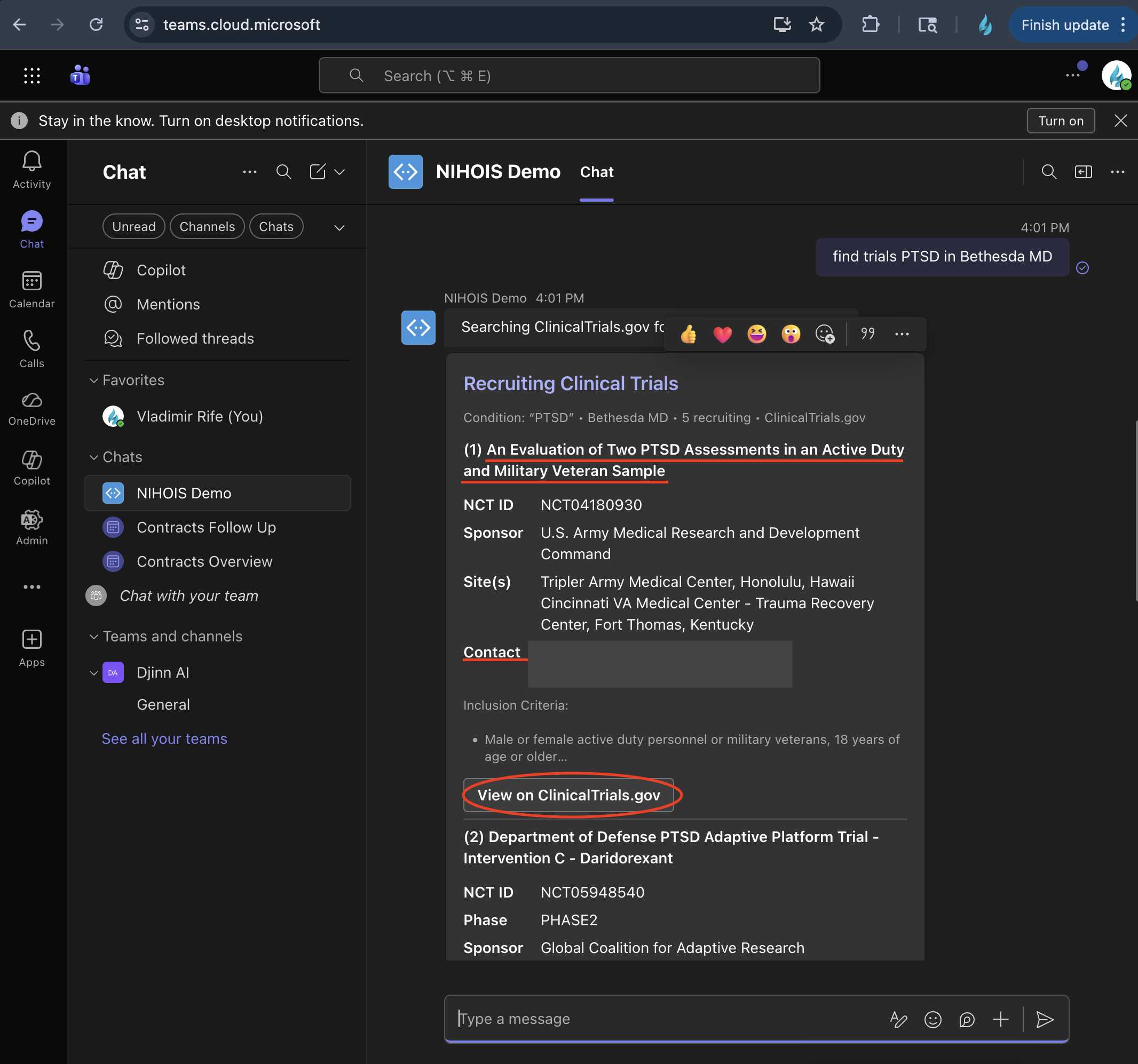
find trials PTSD in Bethesda MD — five recruiting studies from ClinicalTrials.gov, each with the NCT ID, sponsor, sites, a reachable study contact, and inclusion criteria.
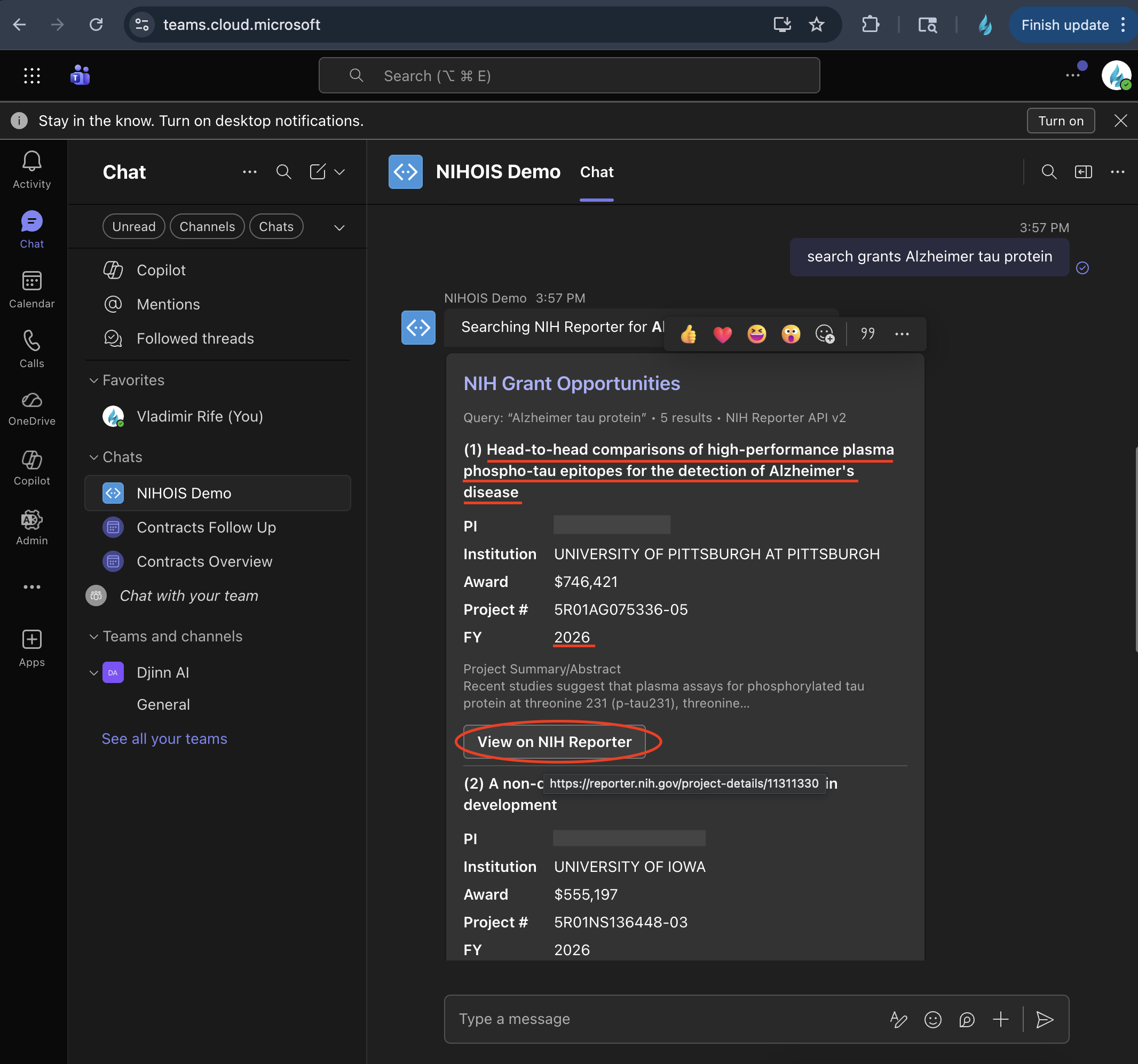
search grants Alzheimer tau protein — five active projects from NIH RePORTER, deep-linked back to the source record on reporter.nih.gov.
These user-prompted interactions are only a demonstration of the People-Project Agent's capability. In production, it runs on its own overnight, sweeping those same directories and public sources to identify room for collaboration with an existing team or new opportunities worth pursuing, before arriving as a single card in the member's personal Teams app each morning. The Portfolio Agent keeps the same daily rhythm, identifying gaps in the member's projects, alerts of effort that might already be duplicated elsewhere in the agency, and how their portfolio aligns with the NIH's strategic plan. The Signal Agent breaks that cadence by design: it stays quiet until a change in the federal budget or policy actually bears on the member's projects or team's personnel, and speaks up to identify any actions needed, if at all.
Outcome: A working PoC, and a clear path to one coherent tool.
In a week we went from an architecture diagram to a working agent in Teams, which settles any questions regarding integrating the rest of the design: the model, the delivery surface, the MCP tool layer, and the accredited cloud boundary have all been proven, in concept, to hold together against live federal data. The steps that remain are (1) to flesh the people-project agent out to completion and (2) develop the remaining two agents using the other relevant channels into the same output format, rather than three separate messages across different channels. That last part is not a packaging preference: it is a requirement of the architecture, as each agent's output is the next one's input, so the full report only appears when they coalesce all information and distill it for that particular member of the agency. We expect such a system to have a Minimum Viable Product (MVP) completed in the span of the first six months, and progressive phases of development, followed by regular maintenance thereafter. It is an exciting new chapter in expanding the capabilities of the NIH, and we look forward the quality of future work that comes of it.
Contact Us Today
Have questions regarding our software or services? Reach out to our team and let's discuss how we can help bring your ideas to life.